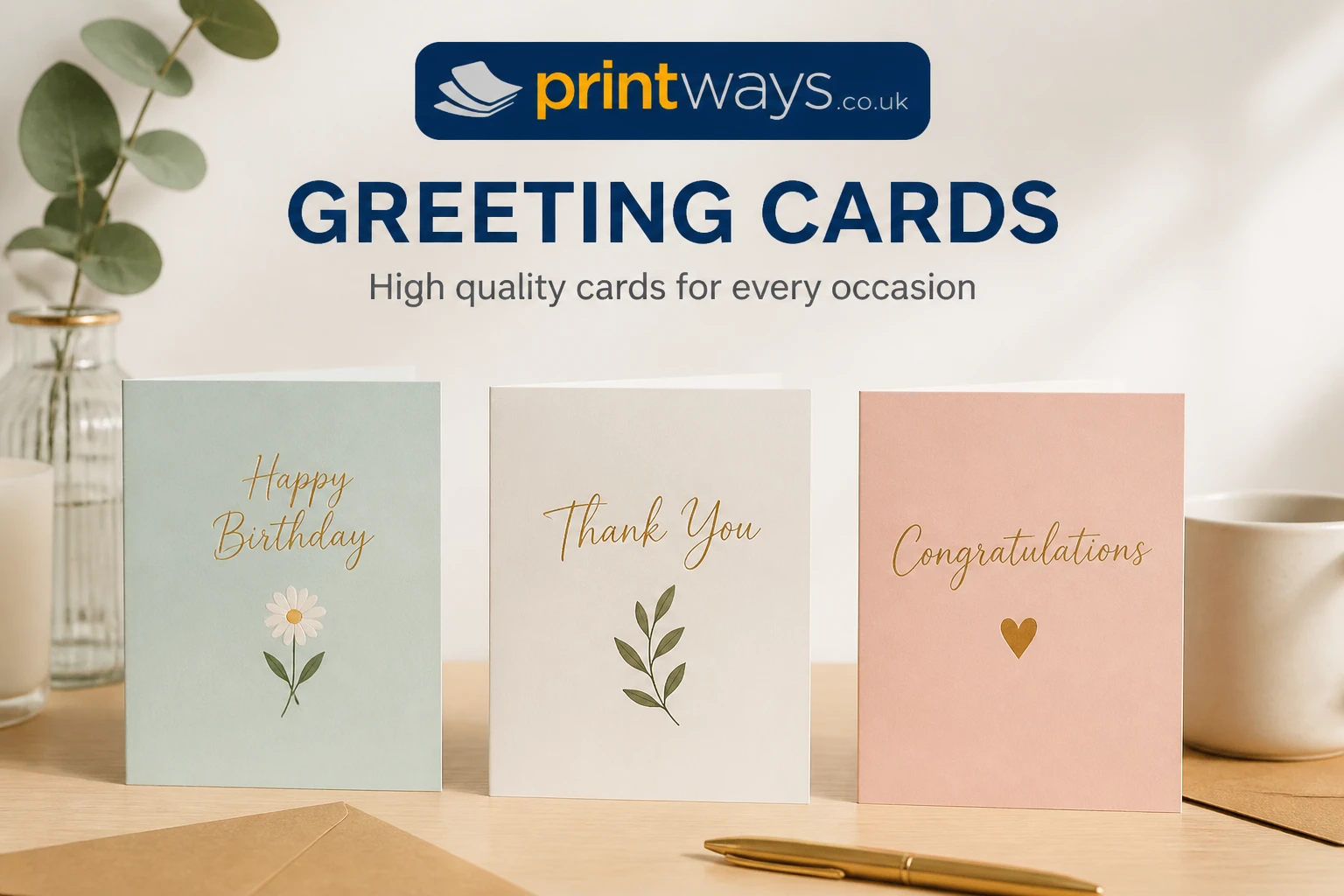
The right greeting card size gives your printed card a balanced and professional appearance. Size, card stock and design all affect the final result, whether you are creating birthday cards, Christmas cards, wedding stationery, thank-you cards or business cards.
A6 remains a popular option. Meanwhile, A5, DL and square formats provide more design choices. This guide covers common UK card dimensions, folded sizes, GSM, paper choices, artwork and printing. Explore greeting card printing UK options from Printways.
Common Greeting Card Sizes in the UK
A6 and A5 are two of the most popular formats for folded cards in the UK. DL and square cards provide useful options for different designs and occasions.
Printways offers A6, A5, DL and 148mm × 148mm square cards. Each format suits different designs, messages and uses.
| Card Format | Finished Folded Size | Approximate Flat Size |
|---|---|---|
| A6 | 105 × 148mm | 210 × 148mm |
| A5 | 148 × 210mm | 297 × 210mm |
| DL | 99 × 210mm | 198 × 210mm |
| Square | 148 × 148mm | 296 × 148mm |
These measurements show the finished folded card. Add bleed to the artwork so the file extends beyond the final trim area.
A6 Greeting Card Size
The A6 greeting card size is 105 × 148mm when folded. This compact format works well for everyday cards, personal messages and business campaigns.
An A6 card gives you room for a front cover, inside message and handwritten note while keeping the card compact.
- Birthday cards
- Christmas cards
- Thank-you cards
- Customer appreciation cards
- Small business cards
- Artist card collections
- Custom cards
- Event cards
For a practical format, order A6 greeting card printing from Printways and select your stock, finish, quantity and turnaround.
A5 Greeting Card Size
The A5 greeting card size is 148 × 210mm when folded. Its larger format gives you more room for photographs, illustrations and longer messages.
A5 cards work well for:
- Premium greeting cards
- Corporate Christmas cards
- Large birthday cards
- Wedding cards
- Luxury thank-you cards
- Branded customer cards
- Illustrated card collections
- Cards with longer messages
An A5 folded card uses an A4-sized sheet before folding. It gives your design a larger canvas.
If your artwork includes detailed photography, illustrations or more text, A5 greeting card printing gives you extra design space.
A6 vs A5 Greeting Cards
Both formats work well. Base your choice on the card's purpose, content and desired visual impact.
Choose A6 when:
- You need a compact, traditional format.
- Your design uses a simple layout.
- Your message is short.
- You need a convenient format for posting.
- You are printing a large card range.
Choose A5 when:
- You need more room for artwork.
- Your card contains a longer message.
- You want photographs or illustrations to stand out.
- You are creating a premium card.
- You need more room for corporate branding.
Choose the format that best suits your design, message, audience, budget and intended use.
Understanding Folded Card Sizes
A folded card starts as a flat printed sheet. The printer then creases and folds the sheet to create the finished card.
An A6 card measures 105 × 148mm when closed. Its flat size is about 210 × 148mm before bleed.
An A5 card measures 148 × 210mm when closed. Its flat size is about 297 × 210mm before bleed.
Understanding the folded greeting card size helps you create the correct artwork. Always check the artwork needs for your selected product.
What Is Greeting Card Bleed?
Greeting card bleed extends the artwork beyond the final trim edge. It allows for small cutting variations and helps prevent white edges.
Printways artwork tip: Add 3mm bleed to every side of your artwork.
Keep text, logos and other important elements safely inside the trim and fold areas.
For an A6 flat size of 210 × 148mm, 3mm bleed on every side creates an artwork size of 216 × 154mm.
Artwork dimensions can vary by product and fold type. Always follow the specifications supplied for your order.
Greeting Card Artwork Guidelines
Good greeting card artwork guidelines help you avoid common printing problems and achieve a sharp, professional result.
Prepare your Printways artwork with:
- PDF, AI, PSD or INDD format
- 300 DPI minimum image resolution
- CMYK colour mode
- 3mm bleed on every side
- Important content away from trim and fold areas
- Correct front, back and inside panel positions
Keep Important Content Away From the Fold
Keep text, logos, faces and other key elements away from the crease. This gives the finished card a cleaner appearance.
How to Design a Greeting Card
Good greeting card design starts with the occasion and audience. Decide what the card should say and what you want the reader to notice first.
Before designing, consider:
- 1 Who will receive the card?
- 2 Which occasion will the card celebrate?
- 3 Which message should stand out?
- 4 Will the card use portrait or landscape orientation?
- 5 How much artwork space do you need?
- 6 Will you use photography, illustration or typography?
- 7 Will you leave space for a handwritten message?
Designing the Front Cover
The front cover creates the first impression. Keep the main idea clear and avoid filling the design with unnecessary elements.
Use strong type, an original illustration, a high-resolution photograph or a simple layout that suits the occasion.
Designing the Inside
Make the inside complement the front cover. Add a printed message, leave room for handwriting or combine both approaches.
Greeting Card Design Ideas
Try these greeting card design ideas for different styles and occasions:
1. Minimalist Typography
Use a clean background and carefully arranged type for a simple, modern appearance.
2. Original Illustrations
Original artwork can give a card its own visual style and help an independent card brand stand out.
3. Photography
High-resolution photographs suit family cards, weddings, seasonal designs and business cards.
4. Custom Designs
Add names, dates, photographs or individual messages for special occasions and customer messages.
5. Corporate Branding
Add your logo, brand colours and visual style to Christmas cards, thank-you cards and customer cards.
6. Premium Finishes
Matt or gloss lamination, soft-touch lamination, Spot UV and selected foil finishes can add extra visual and tactile appeal.
Explore Printways greeting card printing to compare sizes, stocks and finishes.
Greeting Card Paper: Which Stock Should You Choose?
The right greeting card paper affects the appearance and feel of the finished card. Choose a stock that suits your artwork, folding method and desired finish.
350gsm Silk Card
Silk card has a smooth surface with a subtle sheen. It suits colourful artwork, photographs and professional designs.
350gsm Uncoated Card
Uncoated card has a natural surface. Choose it for a traditional look and easy handwriting.
300gsm Invercote
Invercote provides a sturdy card-stock option for selected greeting card designs and finishing choices.
Compare greeting card paper options before placing your order.
What Is the Best Paper for Greeting Cards?
The best paper depends on your artwork, intended use and preferred surface.
Silk card suits colourful illustrations and photographs. Uncoated card offers a natural surface that works well for handwriting.
For a premium look, consider a suitable lamination or special finish.
What Is the Best Cardstock for Greeting Cards?
The best cardstock for greeting cards depends on the balance between rigidity, appearance, writing ability and finish.
Printways offers 300gsm and 350gsm stocks for different card designs and needs.
Consider the folding method, writing needs and planned finishes before choosing your stock.
Greeting Card Paper Weight and GSM
GSM means grams per square metre. The measurement helps compare paper and card weight.
A higher GSM generally means a heavier sheet. However, paper type also affects thickness and feel.
Printways offers 300gsm Invercote, 350gsm Silk and 350gsm Uncoated stocks.
When choosing greeting card GSM, consider the intended use, folding method and finish.
Greeting Cards With Envelopes
A matching envelope completes the presentation of a printed card. Printways offers greeting cards with standard and luxury envelope options through the product calculator.
Including an envelope makes the order ready for gifting, handout or posting.
When ordering greeting cards with envelopes, check that the envelope matches the finished folded dimensions.
Order greeting cards with envelopes from Printways .
How to Print Greeting Cards
When researching how to print greeting cards, start with the correct size and prepare the artwork to professional print standards.
1
Choose Your Card Size
Select A6, A5, DL or square according to your design and purpose.
2
Select the Orientation
Choose portrait or landscape to match your artwork.
3
Choose Your Card Stock
Select silk, uncoated or Invercote according to the look and feel you need.
4
Select Your Finish
Choose from available matt, gloss, soft-touch, Spot UV and foil options.
5
Prepare Your Artwork
Use the correct dimensions, 3mm bleed, image resolution and CMYK colour mode.
6
Check the Fold
Check the front, back and inside panels before submitting your artwork.
7
Upload Your Artwork
Upload your print-ready file and check that the specifications match your design.
8
Review Your Order
Check the size, stock, finish, quantity and turnaround before ordering.
Order greeting card printing online from Printways and use the online calculator to select your specifications.
Greeting Card Printing Tips
Follow these greeting card printing tips for a better finished result:
- 1 Use the correct dimensions. Set up the artwork correctly from the start.
- 2 Use high-resolution images. Printways recommends at least 300 DPI.
- 3 Use CMYK colour mode. Prepare the artwork for professional printing.
- 4 Add 3mm bleed. Extend background artwork beyond the trim edge.
- 5 Keep content away from folds. Leave enough room around creases and edges.
- 6 Choose your stock early. Paper and finish can affect printed colours.
- 7 Proofread your artwork. Check names, dates, addresses and messages.
- 8 Check the envelope size. Make sure the finished card fits inside.
- 9 Consider a proof. A physical sample can help you check an important project.
Greeting Card Printing Templates
Greeting card printing templates make artwork preparation easier, especially for first-time print projects.
A good template should show the trim size, bleed, safe area and fold line. It should also identify the front, back and inside panels.
The correct greeting card template size depends on the chosen format. An A6 card measures 105 × 148mm when closed but uses a larger flat sheet before folding and bleed.
Use the artwork specifications supplied by your printer rather than relying on a generic template.
Custom Greeting Cards
Custom greeting cards can include names, dates, photographs, messages and other details. They can also follow your chosen size, stock, finish and quantity.
Custom cards suit individuals, businesses, artists, retailers and groups that need cards for a specific purpose.
Explore custom greeting cards from Printways for available sizes, stocks and finishes.
Why Choose Professional Greeting Card Printing?
Professional greeting card printing offers heavier card stocks, specialist finishes, accurate trimming and consistent colour print.
Printers can also crease cards before folding. This helps create a clean fold, mainly with heavier stocks.
Printways handles smaller and larger print runs for personal occasions, businesses, artists, retailers and seasonal campaigns.
Greeting Card Printing Online in the UK
Online printing makes it easy to compare card sizes, stocks, finishes and quantities before ordering.
Printways offers A6, A5, DL and square cards, with card stocks, laminations, Spot UV, foil and envelope options.
UK customers can use the online calculator to select their specifications and quantity and view the available pricing.
Ready to Print Your Greeting Cards?
Select your card size, stock, finish, quantity and envelope, then order with care printed cards online.
View Greeting Card Printing Options
Frequently Asked Questions About Greeting Card Sizes
1. Which greeting card size is most common in the UK?
A6 is one of the most widely used formats. It measures 105 × 148mm when folded and provides a useful balance between writing space and compact size.
2. Which greeting card sizes are commonly used in the UK?
Common formats include A6, A5, DL and square cards. The best option depends on your design, message and intended use.
3. What are the dimensions of an A6 greeting card?
An A6 card measures 105 × 148mm when folded. The flat card measures about 210 × 148mm before bleed.
4. What are the dimensions of an A5 greeting card?
An A5 card measures 148 × 210mm when folded. The flat sheet measures about 297 × 210mm before bleed.
5. What are the dimensions of a DL greeting card?
A DL card commonly measures 99 × 210mm when folded. Its narrow shape suits longer and modern layouts.
6. Which square greeting card dimensions are commonly used?
A popular square format measures 148 × 148mm when folded. Square cards offer an option to traditional rectangular formats.
7. What is the difference between finished and flat card size?
The finished size shows the card after folding. The flat size shows the unfolded sheet before folding. An A6 card is 105 × 148mm folded and about 210 × 148mm flat before bleed.
8. What does folded card size mean?
Folded size means the final dimensions of the card when closed. An A6 card, for example, measures 105 × 148mm when folded.
9. How much bleed is needed for greeting card printing?
Printways recommends 3mm bleed on every side of the artwork. This lets background artwork extend beyond the trim edge.
10. What is greeting card bleed?
Bleed is the extra artwork area beyond the final cutting line. It helps prevent white edges caused by small trimming variations.
11. What safe area should be used for greeting card artwork?
Keep important text, logos and other key elements well inside the trim and fold areas. Leave enough space around the crease for a clean finish.
12. What GSM works well for greeting cards?
Printways offers 300gsm and 350gsm stocks. Choose the weight based on the desired feel, folding method and finish.
13. What does GSM mean in card printing?
GSM means grams per square metre. It measures paper and card weight. A higher GSM generally indicates a heavier sheet.
14. Which paper works well for greeting cards?
Silk card suits colourful and photo designs. Uncoated card provides a natural surface that works well for handwriting.
15. Which cardstock works well for greeting cards?
300gsm and 350gsm stocks can provide a professional feel. Choose between smooth, natural and premium finishes according to your design.
16. Is 350gsm suitable for greeting cards?
Yes. 350gsm provides a substantial feel and works well for with care printed cards that require creasing and folding.
17. Is 300gsm suitable for greeting cards?
Yes. 300gsm offers a good balance between weight, rigidity and flexibility. Printways offers 300gsm Invercote.
18. Which finish works best for greeting cards?
The best finish depends on your design. Silk offers a smooth surface. Meanwhile, matt, gloss and soft-touch finishes create different visual effects. Uncoated stock works well when handwriting is important.
19. Can greeting cards include envelopes?
Yes. Printways offers greeting cards with standard and luxury envelope options, depending on the selected product setup.
20. Can I order custom greeting cards?
Yes. You can create cards with your own artwork, names, dates, photographs, messages and other design details.
21. What are custom greeting cards?
Custom cards use your chosen artwork, size, stock, finish, quantity and message instead of an off-the-shelf design.
22. What preparation is required for greeting card artwork?
Use the correct flat dimensions and 3mm bleed. Add high-resolution images, use CMYK, keep key content away from trim and folds, and follow the printer's artwork specifications.
23. What resolution should greeting card artwork use?
Printways recommends at least 300 DPI for professional artwork. High-resolution images help produce sharp printed results.
24. Should greeting card artwork use CMYK?
Yes. CMYK prepares artwork for the four-colour printing process and can reduce differences between screen colours and printed results.
25. Which file format should I use for greeting card printing?
Printways accepts PDF, AI, PSD and INDD artwork formats. PDF is a convenient choice for completed print artwork.
26. Can greeting cards be printed online in the UK?
Yes. Online printing lets you select the card size, stock, finish, quantity and turnaround before placing your order.
27. Which size works well for a custom greeting card?
A6 works well for compact designs. Meanwhile, A5 gives you more room for photographs, longer messages and detailed artwork.
28. How should greeting card artwork be prepared?
Set the artwork to the correct flat size, add 3mm bleed, use high-resolution images and CMYK, keep key content away from trim and folds, check spelling and follow the printer's specifications.
29. What quantity of greeting cards should be ordered?
The right quantity depends on your needs. Smaller runs suit personal events and new designs. Meanwhile, larger runs work well for businesses, retailers and seasonal campaigns.
30. Where can professional greeting card printing be ordered in the UK?
You can order professional greeting card printing from Printways . Choose A6, A5, DL or square formats, along with your preferred stock, finish, envelope, quantity and turnaround.
Order Greeting Cards from Printways
The right greeting card dimensions UK customers commonly use are only part of the final result. Stock, GSM, finish, folding, artwork and envelopes also affect the finished card.
Create cards for personal occasions, business campaigns, retail collections or seasonal events with the specifications that suit your project.
Ready to Order Greeting Cards?
Get premium commercial-grade printing, instant online custom options, and fast free UK delivery direct to your door.
Marcus Hayes
Verified Print Expert UK Commercial Print SpecialistSenior Prepress & Commercial Print Specialist • Printways UK
Commercial print and prepress technical specialist with over 14 years of industrial litho, digital print, and finishing experience. Marcus oversees technical print specifications, file pre-flight inspection, and colour management standards at Printways.